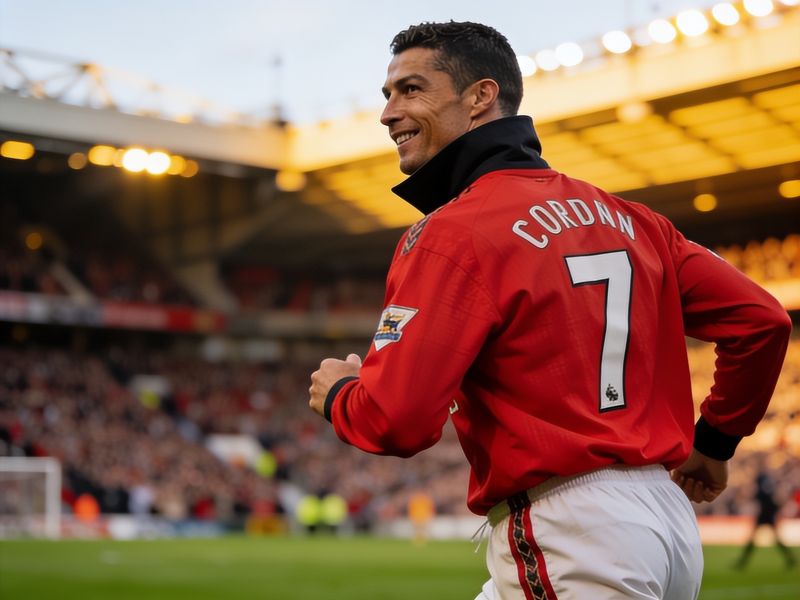
Eric Cantona didn't just play for Manchester United;he redefined what the club could be. Arriving from Leeds in November 1992 for a mere £1.2 million, he inherited the iconic number 7 shirt and immediately transformed a side drifting in mid-table into champions. The statistics are stark: before Cantona, United had won just seven league titles in their history;with him。they won four in five seasons, including two doubles. But numbers only hint at his impact. I remember watching old footage of his first home game against Tottenham—the swagger, the collar upturned, the chest puffed out. He played like a man who knew he was the smartest person in the room, and he made everyone around him smarter too.What made Cantona so singular was his ability to elevate the ordinary into the extraordinary. He wasn't fast, didn't dribble past five players, and rarely scored spectacular solo goals. His genius lay in spatial awareness and timing—that half-second advantage he held over defenders. Take his famous chip against Sunderland in 1996: a perfectly weighted lob from the edge of the box, followed by that imperious, slow-turn celebration. Fans still mimic it. I've seen kids in Manchester playgrounds trying to replicate that pose, collar up。chin high. Cantona understood that football is theatre, and he was the lead actor. His partnership with Mark Hughes and later Andy Cole wasn't just tactical;it was telepathic. He knew where they'd run before they did.
The dark side of Cantona is inseparable from his mythology. The Selhurst Park kung-fu kick in January 1995—launched at a fan who'd hurled abuse—remains the most infamous moment of his career. He received a nine-month ban, a criminal conviction。and a press frenzy that would have destroyed most players. Yet Cantona returned with a vengeance, captaining United to another double in 1996 and winning the PFA Players' Player of the Year. I don't condone violence, but that incident exposed the raw, unfiltered humanity that made him so magnetic. He wasn't a PR robot;
he was a volatile artist who refused to be caged. Sir Alex Ferguson later said that moment forged a deeper bond between Cantona and the fans—a shared siege mentality. The Stretford End still sings his name with a mix of reverence and mischief.Off the pitch, Cantona's influence extended far beyond football. His philosophical musings—'When the seagulls follow the trawler, it's because they think sardines will be thrown into the sea'—baffled pundits but enchanted a generation. He quoted Rimbaud, painted。acted in films, and became a symbol of the intellectual footballer long before it was fashionable. I recall an interview where he described his love for the game as 'the poetry of the effort.' That phrase stuck with me. Cantona saw football as art, not just sport, and he carried that sensibility into his post-playing career. His advocacy for social causes, from housing inequality to refugees, showed a man who refused to be reduced to his athletic achievements. In an era when footballers were increasingly media-trained, he remained gloriously unpredictable.Nearly three decades after his retirement, Cantona's shadow looms over Old Trafford. No number 7 since has truly filled his boots—Beckham came close。Ronaldo had the talent but not the aura, and recent incumbents have struggled under the weight of expectation. The 'Cantona effect' isn't about replicating his skills;it's about capturing his mentality. He played with a chip on his shoulder and a twinkle in his eye, as if he had a secret the rest of us couldn't quite grasp. My own view: United's modern identity crisis stems partly from losing that intangible swagger. They can buy world-class talent, but they can't buy Cantona's conviction. He was the catalyst who turned a sleeping giant into a dynasty, and his legacy is a permanent reminder that football's greatest moments come from characters, not just athletes.